You bloom coffee to vent the carbon dioxide trapped inside the grounds from roasting, so the main pour can soak the bed evenly instead of channelling around pockets of gas. Pour about twice the coffee's weight in water, wait 30 to 45 seconds, then carry on with the rest of your brew.
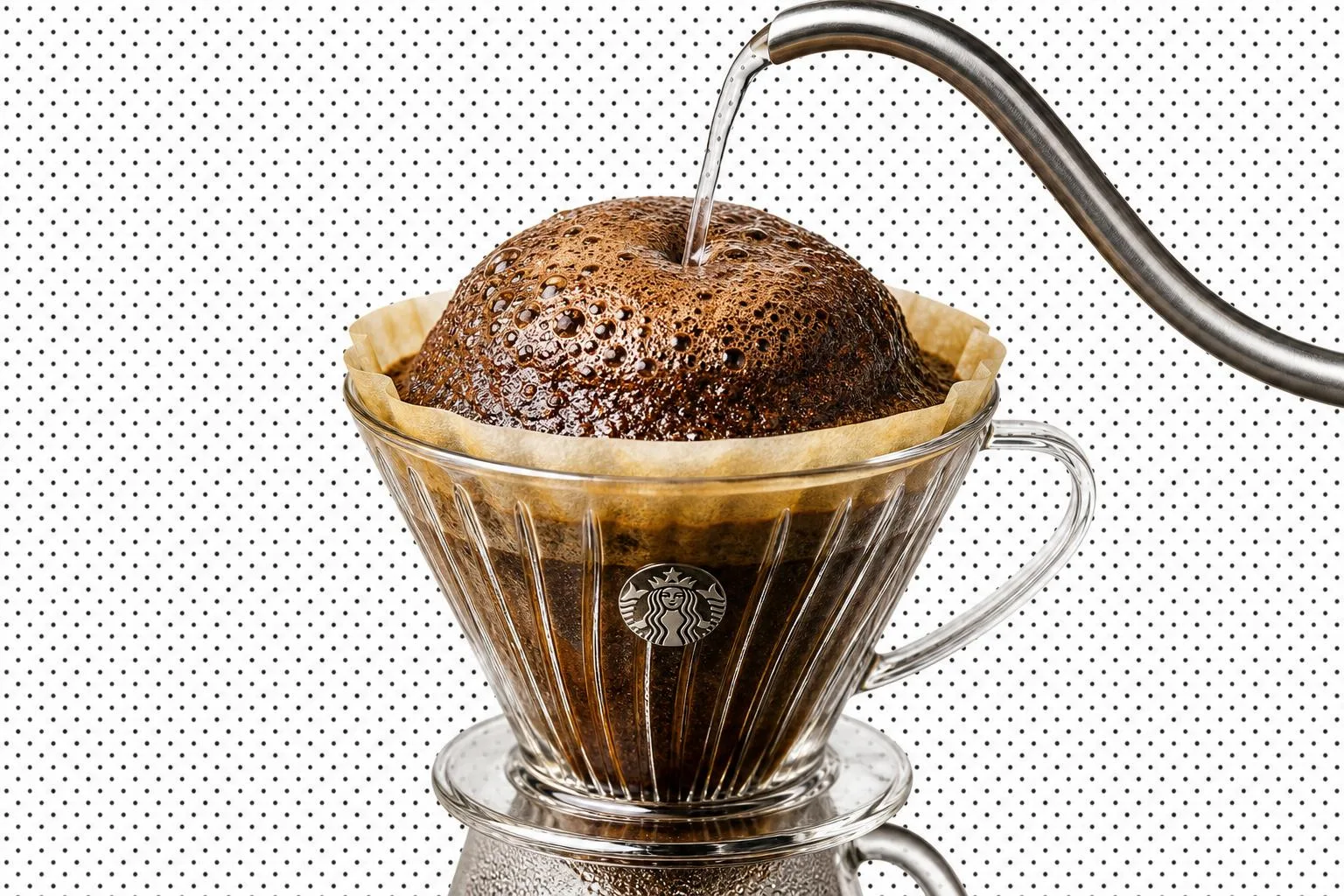
That is the whole job. The bloom is the swelling, bubbling dome you see when hot water first hits fresh grounds, and despite the folklore, it is not flavour being released. It is gas escaping. Flavour extracts steadily across the entire brew, not in that first dramatic rise.
What the bloom actually is
Roasting creates gas inside the bean, and most of it is carbon dioxide. When researchers measured the gas coming off beans during grinding, they found it was about 87% CO2, with small amounts of carbon monoxide and nitrogen and under 1% aromatic compounds.
So when people say "the bloom means the coffee is releasing its flavour," they have the chemistry backwards. The bubbles are almost pure CO2 leaving the grounds. The aromas you smell are just along for the ride.
Roasted coffee holds a real quantity of this gas. Gravimetric studies cite figures of roughly 6.5 to 14 mg of CO2 per gram over the first 30 days, and up to about 16 mg per gram of total trapped gas. That is a lot of gas packed into a small bag of beans.
Why trapped gas ruins an even extraction
CO2 interferes with brewing in two concrete ways. First, it forms a barrier: gas sitting in the coffee bed stops water from touching every ground, so water finds the paths of least resistance and runs around the gas-rich zones. That is channelling, and it gives you an uneven, muddled cup.
Second, escaping CO2 physically pushes water away. The gas resists the flow of water through the bed, which can make a pour over drain faster than you expect and leave a drip machine under-extracting.
Blooming solves both before they start. You wet the grounds with a small splash, the gas rushes out in that 30 to 45 second window, and when you begin the main pour the bed is calm and saturated. Water then moves through it slowly and evenly, which is exactly what you want.
How long to bloom, by freshness
Timing is not one number. It scales with how recently the coffee was roasted, because degassing is fastest when beans are freshest and slows as they age. Here is a practical guide:
- Very fresh, 1 to 5 days off roast: bloom 45 to 60 seconds.
- Peak filter window, 6 to 14 days: bloom 30 to 45 seconds.
- Older, 15 or more days: 20 to 30 seconds is usually plenty.
Most bags you brew from will sit in that middle window, which is why 30 to 45 seconds is the standard advice. If you grind and the bed erupts into a tall, lively dome, lean towards the longer end. If it barely moves, cut it short.
Grinding accelerates everything, which is why you bloom ground coffee rather than whole beans. In the first few minutes after grinding, reports put CO2 loss as high as 40 to 50% of the total, and in some studies 59 to 73%. The clock starts the moment the burrs turn.
This is also why you should grind fresh and brew straight away. Pre-ground coffee has already shed much of its gas before it reaches your kettle, so its bloom is weaker and its cup flatter. The bloom you see is partly a reward for grinding at the last minute.
The too-fresh problem
There is a real counterpoint to "fresher is always better." Beans less than three or four days off roast can bloom so violently that the reaction fights your brew instead of helping it. The excess CO2 keeps shoving water away from the grounds well past the normal 45-second window, and no amount of careful pouring gets you to an even extraction.
This is exactly why roasters rest coffee before they sell it. In those first very fresh days the gas leaves so fast it causes uneven extraction and a thin, sometimes sour cup. Letting a bag settle for a few days to a week lets the worst of the degassing pass.
Roast level matters here too. Darker roasts hold and shed more CO2: one set of measurements found dark roasts diffused about 8.5 mg of CO2 per gram over more than 400 hours, against 2.7 mg per gram for light roasts. A very fresh dark roast is the most likely to misbehave, so give those extra rest.
How to bloom, step by step
The mechanics are simple and worth getting right.
- Use roughly twice the coffee's weight in water. For 20 g of coffee, pour about 40 g. Ground coffee takes on around twice its weight before it saturates, so less than this will not release enough gas, and much more floods the bed and starts the real brew early.
- Pour to wet all the grounds. A gentle spiral or a quick swirl of the brewer helps every ground get wet. Dry pockets keep their gas.
- Wait your freshness-appropriate time, 30 to 45 seconds for most coffee.
- Begin the main pour once the dome has risen and started to settle.
A set of digital scales makes this repeatable, and if you want the exact bloom and total water for your dose and ratio, the brew calculator will do the sums for you.
Common bloom mistakes
The most frequent error is pouring too little water, so only part of the bed gets wet and the dry grounds hold onto their gas until the main pour, where they channel. Err towards wetting everything evenly rather than conserving water here.
The opposite error is pouring too much, which drowns the bed and effectively starts your extraction during the bloom. Twice the coffee weight is the sweet spot because that is roughly how much water the grounds can absorb before they saturate and start to drip.
The last mistake is treating 30 seconds as a fixed law. Watch the coffee, not just the timer: a dome still visibly bubbling wants a little longer, while one that has collapsed into a flat, cratered puck has finished degassing and is ready for the main pour.
When blooming matters most
Blooming earns its keep on gravity brewers: the V60, Chemex and Kalita Wave. With these, water simply falls through the bed, so any gas still escaping during the main pour disrupts the flow and the extraction. Clearing it first is the single easiest way to make a pour over taste cleaner.
Immersion brewers like the French press care less, because the grounds sit submerged and you stir anyway, but a brief bloom still helps wet everything evenly. On espresso you do not bloom by hand: the machine's pre-infusion wets the puck and vents some gas automatically, though a few seconds of low-pressure pre-infusion does a similar job.
The bloom is also a freshness test
Useful bonus: the bloom is the best at-home freshness check you have. A dramatic, vigorous dome that rises high and holds its shape for the full 45 seconds signals beans roasted within the last one to two weeks. A modest bloom that rises little and settles fast points to coffee in the two to four week range, still drinkable but past its best. A flat bloom that barely stirs means stale or poorly stored beans.
So watch what your coffee does. It tells you both how long to wait and whether the bag is still in good shape.
For a lively bloom and the clean, bright cup that rewards a careful pour, a fresh light-roast washed Ethiopia is a perfect teacher. This Yirgacheffe is delicate, citrus-led and floral, exactly the kind of coffee where an even extraction pays off.

If you prefer a fruit-forward natural, one with berry and tropical notes shows off how much cleaner a well-bloomed bed tastes when the cup is this expressive.

What to do first
Next time you brew, weigh your dose, grind, and pour twice that weight in water. Watch the dome, wait 30 to 45 seconds, and only then start the main pour. That one habit fixes more uneven, fast-draining brews than any gear upgrade.
Then let your bags rest a few days after roast before you expect their best, and give dark roasts longer. When you are ready to push further, our pour over guide walks through the full recipe around the bloom.