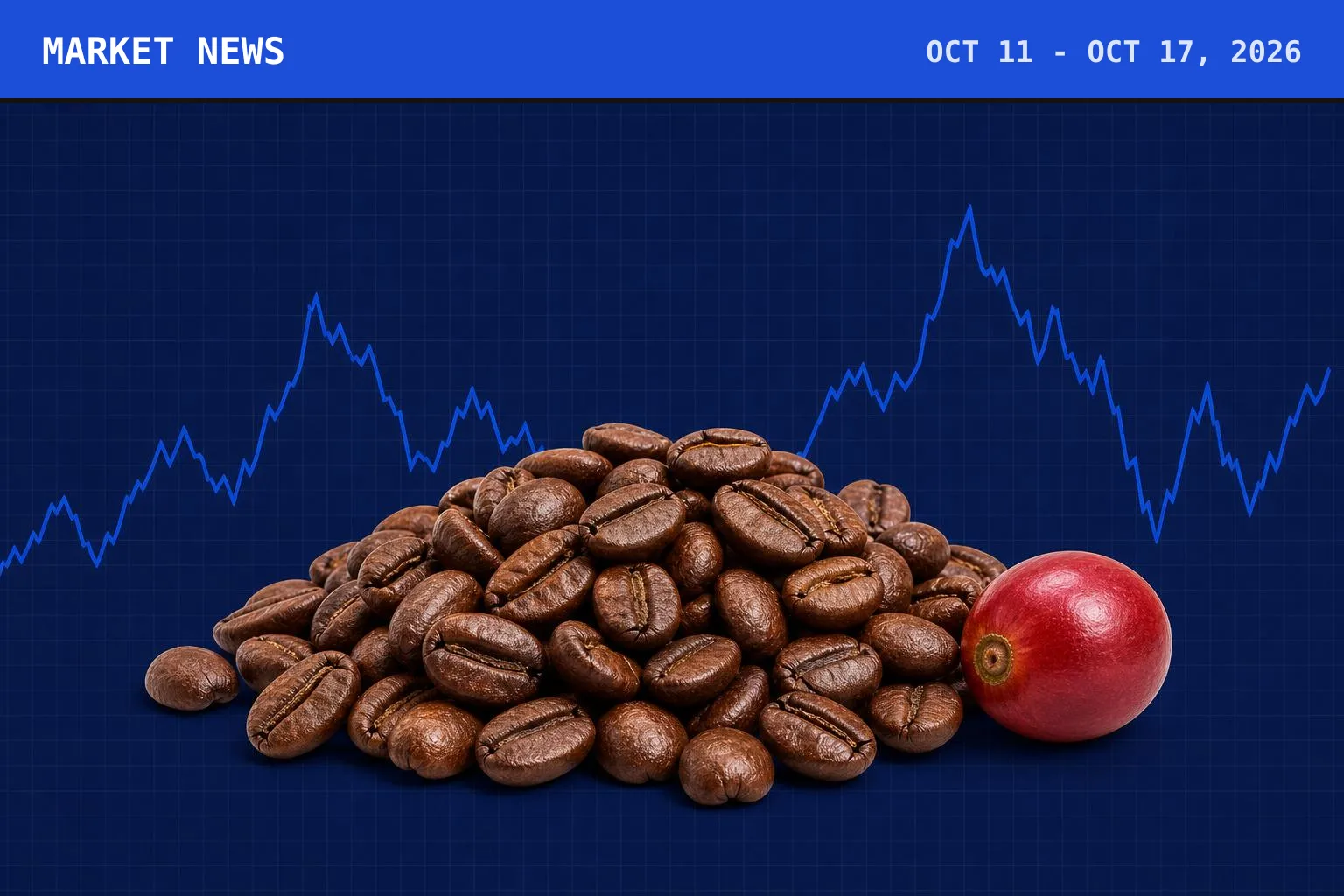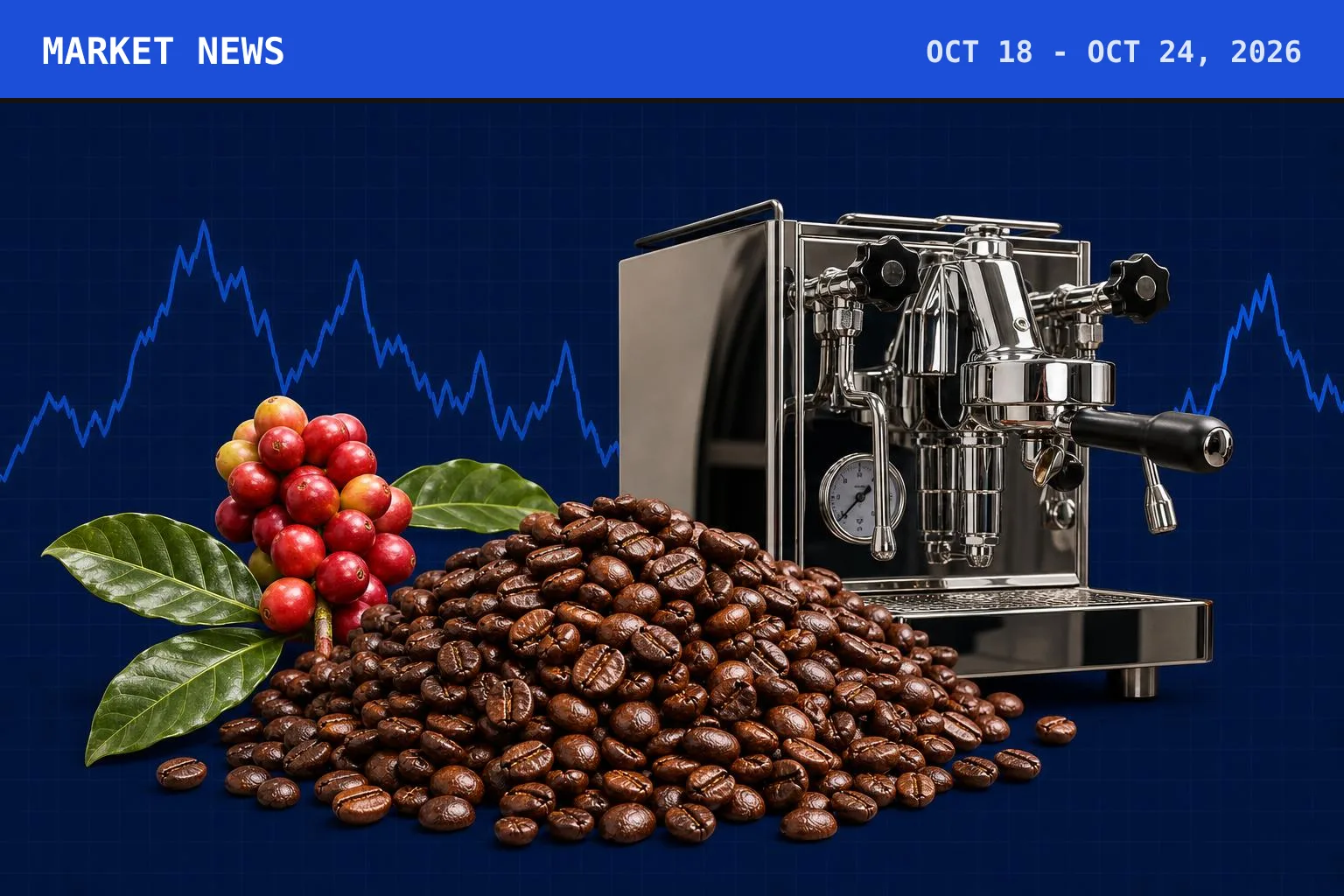
The week's loudest move came from the futures screen: ICE arabica vaulted to a one-month high on Monday as exchange warehouse stocks sat near a 27-year low, then gave some of it back as traders cashed out. By Thursday the rally had cooled, but prices held firmly above $3 a pound.
For anyone buying coffee, the takeaway is simple. The supply picture behind the shelf is still tight, and the companies that fill your cupboard are planning around higher costs, not lower ones.
The market: arabica jumps, then gives some back
| Market | Price | This week |
|---|---|---|
| Arabica (ICE Dec) | 309.83 ¢/lb | +1.38% |
| ICO Composite | 270.31 ¢/lb | +1.64% |
| Colombian Milds (ICO) | 370.53 ¢/lb | +1.63% |
| Other Milds (ICO) | 350.06 ¢/lb | +2.43% |
| Brazilian Naturals (ICO) | 308.77 ¢/lb | +2.51% |
| Robustas (ICO) | 164.25 ¢/lb | -0.66% |
The December arabica contract settled at 315.70 cents a pound in New York on Monday 19 October, up 3.3% on the day and a one-month high. Having traded near 285 cents only a week earlier, it had gained roughly 11% as certified stocks drained.
The spark was scarcity. Certified arabica inventories in New York hit their lowest since 1999 in mid-September, and analyst Judy Ganes told Bloomberg that some traders could be squeezed if stocks stay low.
Not everyone read it as a supply panic. NRT analyst Vicente Zotti said the rise was mainly short covering rather than any change in the weather outlook, with futures climbing faster than physical prices while large volumes stay stored in Brazil.
That distinction matters for the shelf. Short covering is traders buying back bets they had placed against the market, a mechanical squeeze that can reverse quickly, rather than a genuine shortage of beans in the world. Renewed El Niño chatter added fuel, but the physical supply had not changed overnight.
The froth then came off. On Tuesday the December contract fell 1.4% to 311.30 cents, pressured by profit-taking after 28,000 bags of arabica turned up pending grading at ICE, the highest figure in over a month. By Thursday 23 October it closed at 309.83 cents, down 0.84% on the day.
More bags arriving for grading is a small but telling signal. It suggests holders see current prices as high enough to be worth selling into, which tends to cap rallies. For now that leaves arabica in a tense balance: tight stocks pulling up, fresh supply nudging down.
Robusta went the other way: in London, the January contract rose 2.2% to close at US$3,480 a tonne. The ICO's indicator indices climbed across the window too, with the composite reaching a monthly high of 272.34 cents on 19 October before easing to 270.31 by 21 October.
The consumer signal was the clearest part of all. JM Smucker, which owns Folgers and Bustelo, postponed planned price cuts, citing the direction of futures markets. In plain terms: do not expect supermarket coffee to get cheaper while the exchange keeps firm.
De'Longhi takes near-full control of La Marzocco
The biggest corporate move of the week was in espresso hardware. De'Longhi, the Italian appliance group, paid 662.5 million euros (US$744 million) to raise its stake in the professional coffee business that houses La Marzocco and Eversys from about 61% to 88.02%.
The deal completed on 16 October and bought out DLI Limited's entire holding. It valued the division at a 2.36 billion euro enterprise value and roughly 2.5 billion euros of equity, a striking number for a maker of cafe espresso machines.
For drinkers this is less about your kitchen and more about the trade. La Marzocco machines sit behind the bar at a huge share of specialty cafes, so a single owner now controls both the home-appliance giant and one of the prestige professional names.
Consolidation like this rarely lowers prices, but it does tend to pour money into product development and distribution. Expect the two brands to stay distinct on the shelf while sharing engineering and supply chains behind the scenes.
Nestlé beats estimates as coffee holds up
On Thursday Nestlé reported third-quarter organic sales growth of 4.0%, led by Petcare and Food & Snacks and beating the 3.42% analysts expected. Coffee was part of the story, not a drag on it.
The company said coffee sales grew in North America after earlier price increases at brands including Starbucks and Nescafe. That is the quiet pattern of this whole cycle: higher shelf prices are sticking, and volumes have mostly held.
It is the same logic behind Smucker's paused price cuts. When green coffee costs this much, the big roasters are protecting margin rather than chasing a price war.
For the household buyer, the lesson is to stop waiting for a discount that is not coming this quarter. A bag you actually enjoy, bought and stored well, is worth more than a cheaper bag you will not finish.
Starbucks leans into Halloween
Starbucks spent the week on seasonal theatre rather than strategy. On 22 October it added a Black Cat Frappuccino blended beverage and a Venti Black Night Cookie to menus at select US coffeehouses, running as a limited offer through Halloween.
The more consequential date is next Thursday. Starbucks plans to release its fourth-quarter and full fiscal year 2026 results after market close on 29 October, which will show how those earlier price hikes landed with customers.
That report is worth watching even if you never set foot in a Starbucks. As the largest chain, its traffic numbers are a read on whether coffee drinkers are trading down or simply paying up.
Elsewhere in coffee
The sport of coffee came to Central America. The 2026 World Barista Championship got underway in Panama City, running 22 to 25 October and bringing together more than 50 national champions.
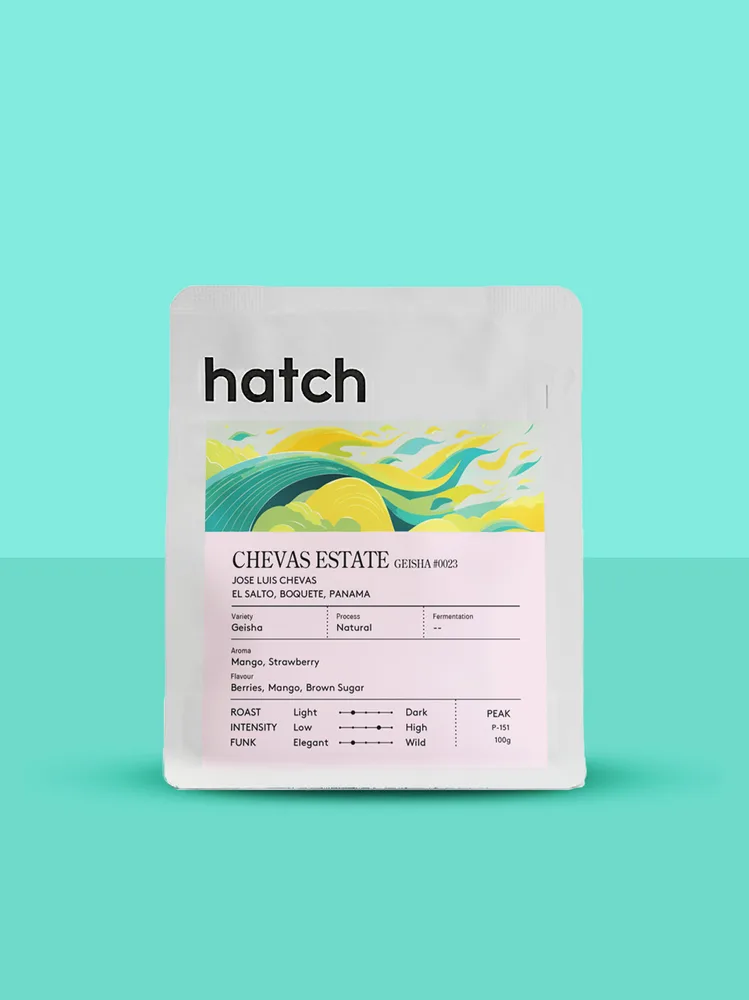
It is being held alongside World of Coffee Panama, the first time both events have taken place in Latin America. Fittingly, the host country is the home of competition-grade Geisha, the perfumed variety that routinely tops auctions.
If the championship has you curious about what a world-class Panama lot tastes like, a natural Geisha is a gentle way in: floral and tropical, with a syrupy body the washed versions trade away for clarity.
Colombia stayed in the spotlight too. On 23 October Clearpath Coffee and M-Cultivo announced a Colombia Legends auction for 16 November, with 15 lots from some of the country's most awarded producers, including Nestor Lasso, Jhonatan Gasca, Johan Vergara and Astid Medina.
Auctions like this are where record prices for Colombia get set, and they tend to drag the whole top tier of the market upward. If you want a taste of what these growers are chasing without the auction premium, the catalogue has plenty of accessible Colombian lots across washed and experimental processing.
Finally, the regulatory grind continued. The EU-backed Sustainable Coffee Exchange project, run with JDE Peet's and SNV, is supporting 65 coffee enterprises in Vietnam toward ESG and EUDR deforestation standards through 2029, working in the Lam Dong and Son La regions.
It is slow, unglamorous work, but EUDR compliance is quietly reshaping how green coffee moves into Europe. Smallholders who can prove their land is deforestation-free will keep market access; those who cannot risk being squeezed out, which adds another cost layer to the cup.
What to watch next week
Two things will set the tone. First, whether arabica can hold above $3 now that the short-covering spike has faded and more bags are turning up for grading at ICE.
Second, Starbucks earnings on 29 October, the clearest read yet on whether higher menu prices are costing the chain customers. Watch, too, for the results of the World Barista Championship in Panama, which often nudges attention toward the origins and varieties the winner brews.
If the week has you wanting to buy rather than read charts, start at the catalogue or let the decision helper narrow it down. Prices on the shelf are not falling soon, so a coffee you genuinely enjoy is the best hedge there is.