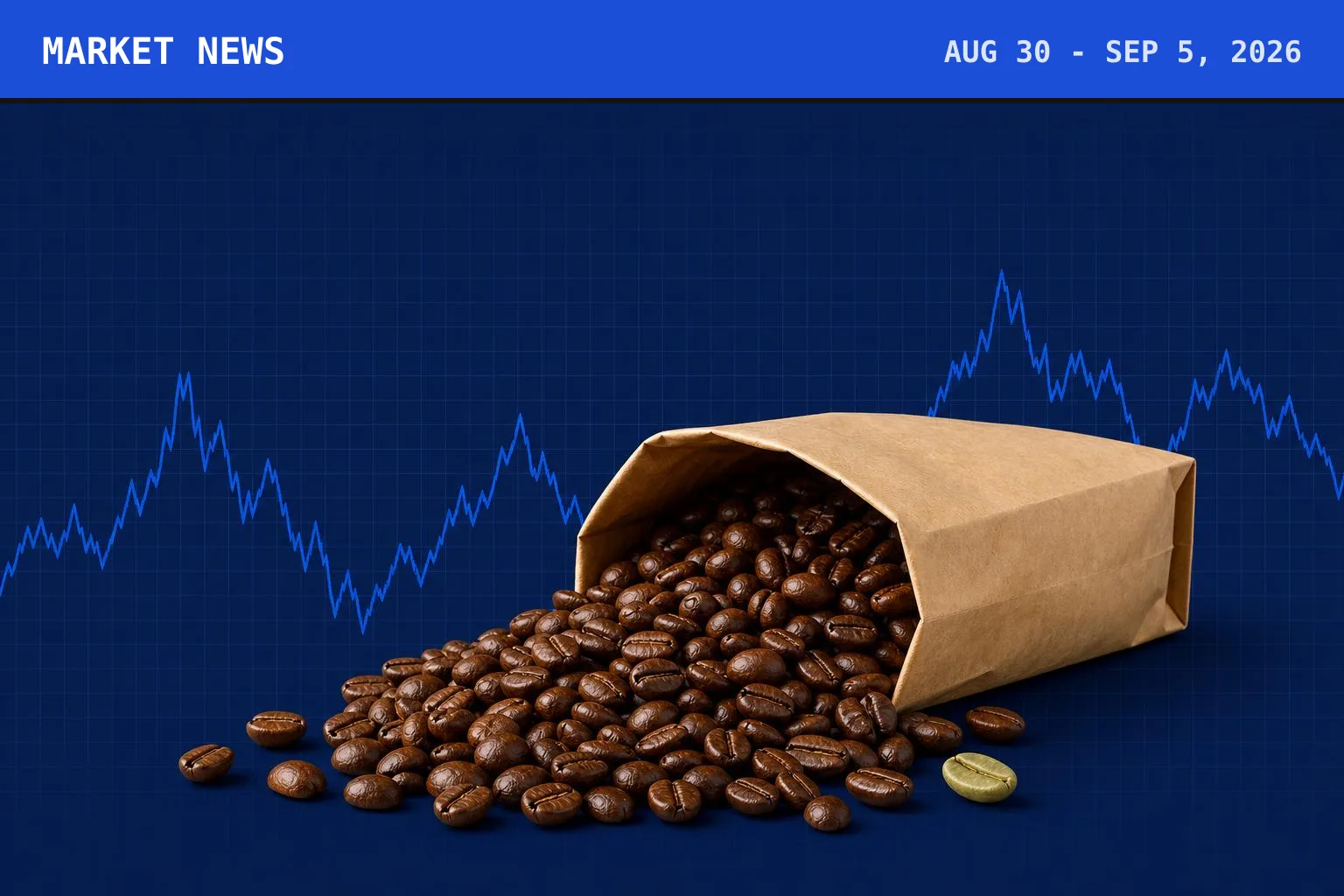
Arabica spent this week falling. By midweek the front-month contract had dropped to a fresh five-week low, extending a slump that began the week before, and the reason was simple supply: Brazil is finishing a very large harvest and shipping more of it.
For anyone buying coffee, this is the friendlier direction. Weeks like this one, where the giant grower loosens the taps, are what eventually take some heat out of shelf prices, even if the beans in your cupboard were bought at last season's cost.
The market: supply pressure across the board
| Market | Price | This week |
|---|---|---|
| Arabica (ICE Dec) | 295.60 ¢/lb | -0.80% |
| Robusta (ICE Nov) | $3,366/tonne | -1.20% |
| ICO Composite | 268.38 ¢/lb | -4.10% |
| Colombian Milds (ICO) | 368.53 ¢/lb | -3.17% |
| Other Milds (ICO) | 340.80 ¢/lb | -3.42% |
| Brazilian Naturals (ICO) | 303.07 ¢/lb | -3.93% |
| Robustas (ICO) | 168.68 ¢/lb | -2.49% |
The selling was sharpest early in the week, when December arabica closed down 1.41% and November robusta fell 2.89%, dragging arabica to a one-month low and robusta to a two-and-a-half-month low. By Wednesday and Thursday arabica had ticked down again to a fresh five-week low around 289.75 ¢/lb before settling near 295.60, with robusta touching $3,330 a tonne.
The driver was harvest maths. Safras & Mercado reported on Monday that Brazil's 2026/27 harvest was 97% complete as of 26 August, and StoneX lifted its outlook for the crop to a record 77.2 million bags, 2.6% above its March estimate.
Those numbers matter because the market spent the northern summer worrying about tight supply. A record crop that is almost entirely picked replaces fear with fact, and traders sell into that certainty. The 97% figure is a touch behind last year's 100% and the five-year average of 98%, but not enough to spook anyone.
Dealers also pointed to a pick-up in exports from Brazil easing short-term tightness, while returning rains bode well for next year's flowering. More coffee leaving port now, and a healthier crop brewing for later, is a bearish combination.
The two beans did split on one measure. ICE arabica inventories fell to a low of 223,976 bags, which is quietly bullish, while certified robusta stocks climbed to a 9.25-month high of 4,956 lots, which is the opposite. Tight arabica warehouses are the main reason prices did not fall further.
That split is worth holding onto. When the exchange-monitored arabica stockpile keeps draining, it puts a floor under the price even on a week when everything else points down. Robusta has no such support right now, which is why it led the falls.
The International Coffee Organization indicators told the same story in slower motion. The Composite index dropped from 279.85 US cents on 1 September to 268.38 by the 3rd, and every group indicator fell with it: Colombian and Other Milds, Brazilian Naturals and Robustas all lost ground over the same three days.
Keurig Dr Pepper reshuffles its coffee empire
The week's biggest corporate move came on Tuesday, when Keurig Dr Pepper announced it will sell its entire equity stake in the yoghurt maker Chobani back to the company for $800 million. Chobani, in turn, will buy KDP's manufacturing plant and warehouse in Allentown, Pennsylvania for about $125 million.
Why should a coffee drinker care about a yoghurt deal? Because it is part of a much bigger reshaping. KDP bought the Dutch coffee and tea group JDE Peet's for $18 billion in April, and it is now preparing to split into two separate public companies, one for coffee, one for the rest.
That coffee arm would sit on some of the most recognisable names on the shelf, from Keurig pods to JDE Peet's brands like Douwe Egberts and L'OR. Selling off the Chobani stake and its factory is the kind of tidying a company does when it wants each half to stand cleanly on its own before a split.
Deals like this rarely change what is in your cup next week. But they quietly decide who owns the roasters behind the supermarket aisle for years to come, and how much muscle sits behind the pods and instant tins most of the world actually drinks.
Starbucks lines up its fall menu
Starbucks spent the week trailing autumn. On 31 August it confirmed that the Aerocano, an iced espresso drink, and three new Mini Pies in Apple Crumble, Pecan and Pumpkin flavours will land on 29 September, timed for National Coffee Day.
Then on 3 September it announced a Peanuts tie-in. From 15 September, Starbucks cafes worldwide will sell a limited merchandise collection inspired by "It's the Great Pumpkin, Charlie Brown".
Menu launches and merch drops are the machinery of a big chain's autumn, and they matter mostly as a reminder of scale. When Starbucks moves its seasonal calendar, it moves a lot of milk, syrup and, underneath it all, a great deal of coffee.
Elsewhere in coffee
The hardest news came from Hawaii. Coffee farms across the south of Hawaii Island are counting crop, tree and infrastructure losses after Hurricane Lala brought damaging winds and extreme rain, striking just as many growers were starting the 2026 harvest. For a tiny, high-cost United States origin, timing like that hurts.
There was a sobering story from the retail side too. The owner of City Watch Coffee, a two-location company in Pennsylvania, announced plans to sell the business and move to Cambodia after her husband and co-owner was detained by US Immigration and Customs Enforcement. It is a reminder that the people behind a cafe counter carry lives well beyond the espresso machine.
On a lighter note, the trade calendar filled up. Caffè Culture returns to London's Business Design Centre on 29 and 30 September with an expanded program, including a new Discovery Village, a Cupping Village and a larger specialty tea area.
And in a neat experiment, twelve roasteries from Germany, Switzerland, Austria, Italy, France and Slovenia will roast the same green coffee on three identically configured Giesen roasters. It is a rare chance to isolate the roaster's hand from everything else, and to see how much of a coffee's character is decided after the farm rather than on it.
What it means at the shelf
A week of falling futures does not reach your favourite bag straightaway. Roasters buy months ahead, and specialty prices lean more on quality, farm relationships and freight than on the daily screen.
But a record Brazilian crop and heavier exports are the kind of pressure that, sustained, eventually cools the whole market. If exports keep flowing and the weather holds for next year's flowering, the direction of travel is gently downward.
It is also a good week to enjoy what Brazil does well. A clean natural Brazilian is nutty, chocolatey and gentle, the base note under most of the world's espresso, and it forgives a slightly imprecise brew better than a delicate Ethiopian lot will.
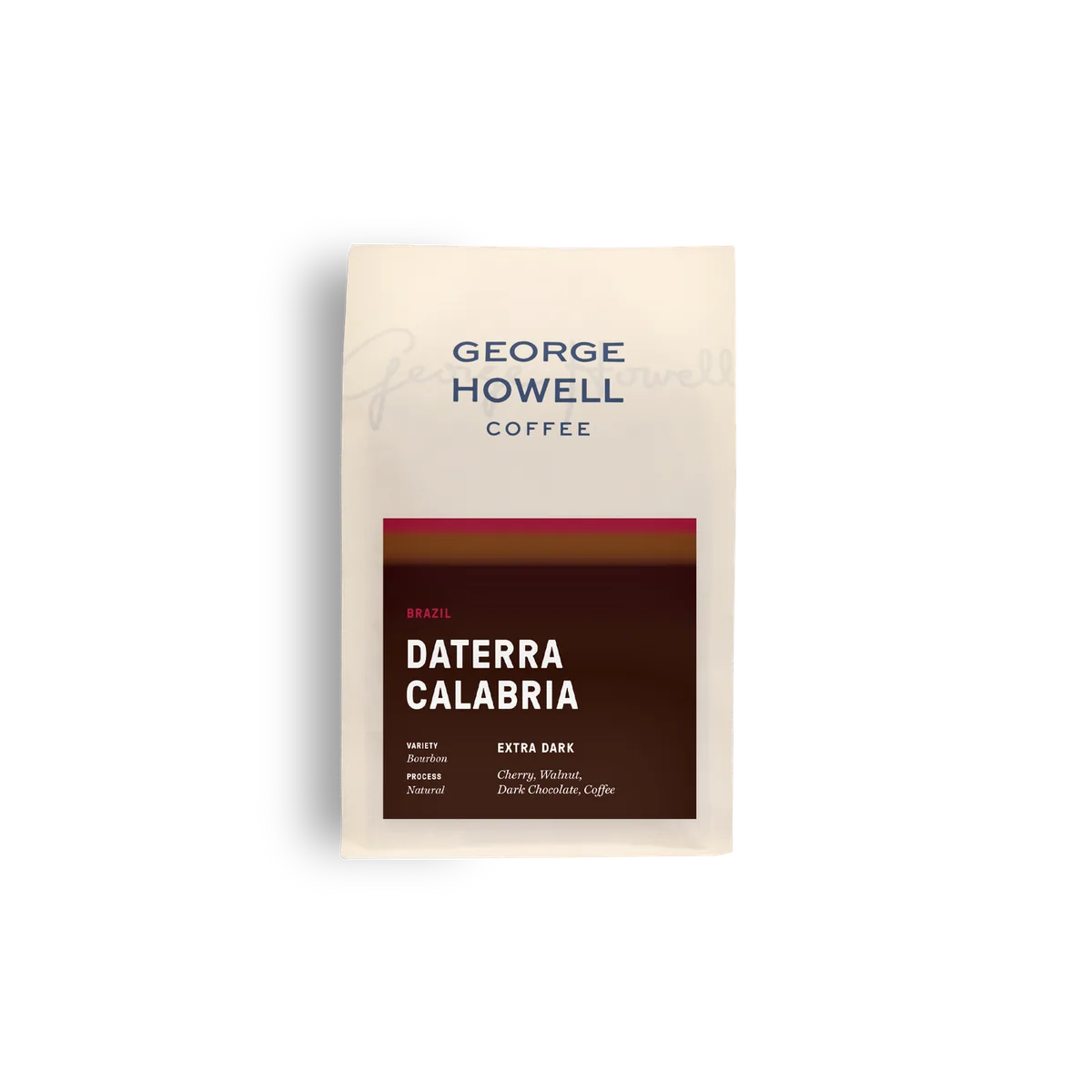
This Daterra lot from George Howell is a good example of the style, a light-roasted natural with winey, chocolatey depth and enough clarity to enjoy black.
If you would rather chase the brighter end, Kenya and Colombia still hold their premiums, as this week's milds indicators showed even while falling. A washed Kenyan with its blackcurrant snap remains a world away from a soft Brazilian natural, and prices this week did not change that.
Worth watching next week
Two things to track. First, whether Brazil's export pace keeps building, because that, more than any single day's chart, is what is pushing arabica down right now.
Second, those split inventories. Draining arabica warehouses against a nine-month robusta high is a tension that usually resolves one way or the other, and it will shape which bean moves next. If you are deciding what to buy while prices wobble, our decide tool and the brew calculator are the calmer places to start.