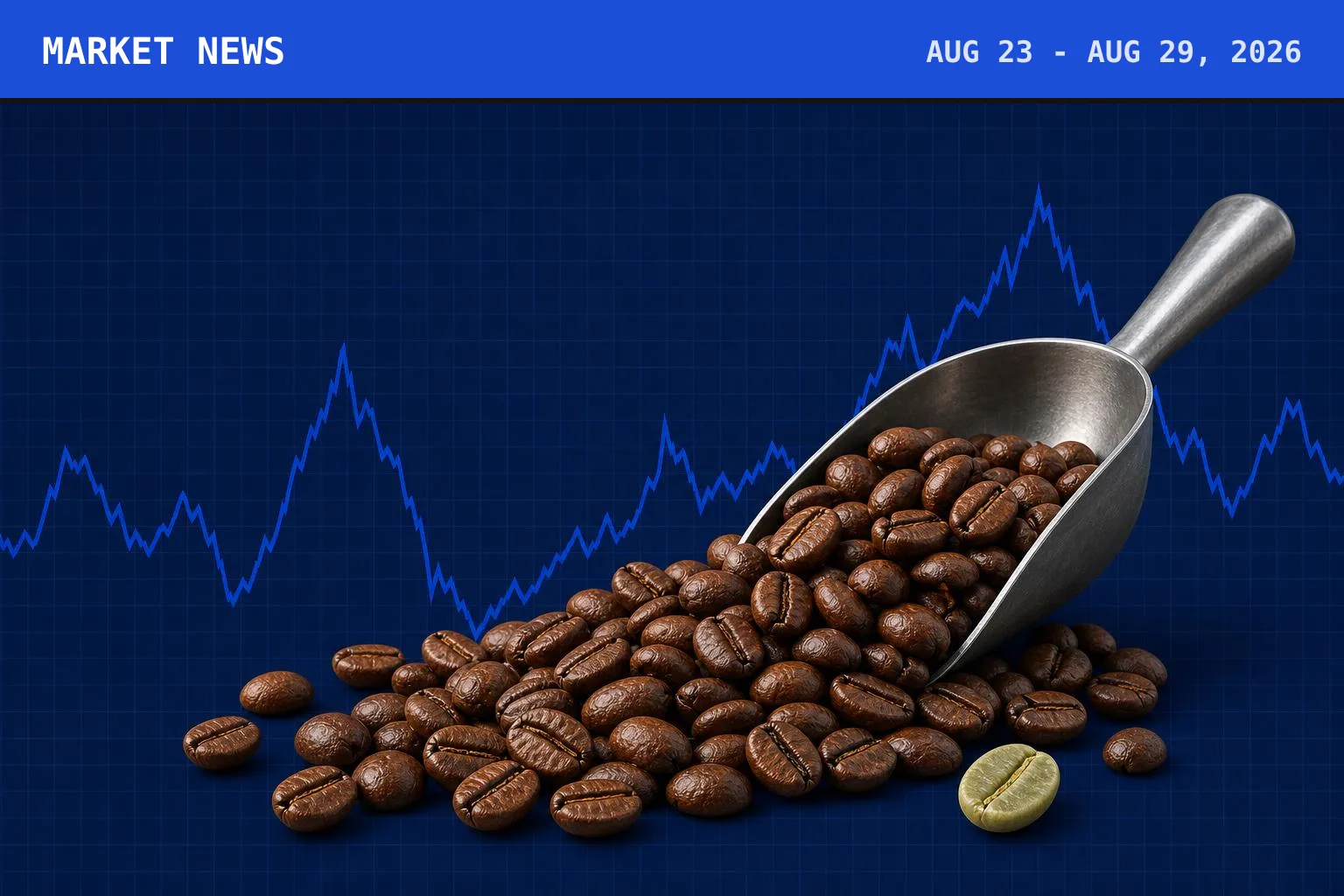
Arabica gave traders whiplash this week. Prices tore to their strongest level in more than seven and a half months on Monday, August 24, then unwound the entire move by Thursday as the outlook for Brazil's harvest calmed nerves.
For anyone buying beans, the takeaway is simpler than the chart. The market is jumpy right now, but the medium-term story still points toward more supply, not less.
Here is where the two futures markets closed the week.
| Market | Price | This week |
|---|---|---|
| Arabica (ICE Dec) | 309.65 ¢/lb | -4.03% |
| Robusta (ICE Nov) | $3,561/tonne | -1.63% |
The two headline numbers hide a wild ride in between. Both contracts closed the week lower, but only after arabica had first surged nearly 6% in a single Monday session.
Why prices whipsawed
Monday delivered a decisive technical breakout. December arabica jumped 19 cents, or 5.89%, to settle at 341.65 cents per pound, trading as high as 342.55 and reaching its strongest level in over seven and a half months. Robusta joined in, its September contract closing up 5.34% the same day.
Breakouts like that tend to feed on themselves. When a price clears a level chart-watchers have been eyeing for months, automated buying and short-covering can pile on quickly.
Monday had all the hallmarks of that kind of technical rush rather than a fresh supply shock. No new harvest failure or shipping crisis drove the spike; it was momentum meeting a thin late-summer market.
The rally did not hold. On Thursday, December arabica shed 12.50 cents, or 3.88%, to settle at 309.65 cents, a two-and-a-half-week low, while robusta sank to a two-month low in its second straight day of selling.
Two things pulled prices back down. Traders saw signs that Brazil's harvest would add more supply than feared, which sparked heavy long liquidation as speculators bailed out of bullish bets.
Brazil's Cooxupe co-op reported midweek that 87.5% of its harvest was complete as of August 21. A steady, near-finished harvest is exactly the reassurance a nervous market wanted, and it undercut the argument for holding onto Monday's spike.
By Friday, attention had shifted again, this time to weather. El Nino is fast becoming the central theme for the 2026/27 outlook, with concerns focused on Vietnam and Colombia, and that kept coffee under pressure into the weekend.
The bigger supply picture
A fresh Reuters poll reset expectations for the year ahead. Contributors now see arabica falling to around US$3 per pound by year-end, with robusta recovering slightly to about US$3,900 per tonne.
The same poll expects a modest 1.7-million-bag global surplus for 2025/26, widening sharply to 8.2 million bags in 2026/27. Most of that swing comes from a projected 17.2% jump in Brazilian output to 75 million bags.
That forecast is the anchor beneath this week's slump. If Brazil really does add that much coffee, the arithmetic tilts toward cheaper beans over the coming year, and traders are already pricing some of it in.
The warehouse story is more divided. ICE arabica inventories fell to a 2.75-year low of 226,242 bags on Monday, just above the November 2023 trough of 224,000 bags. A further drop would take them to the lowest since 1999.
Robusta went the other way, with ICE stocks jumping to a nine-month high on Tuesday. Tight arabica supply is the one factor still supporting prices even as the harvest and the forecasts point lower.
That split matters for what lands in your cup. Arabica scarcity keeps a floor under the specialty coffees roasters buy, while ample robusta softens the cost of the commodity blends that fill supermarket tins and instant jars.
It is also why the two futures markets can move in opposite directions on the same day. When you read a headline about "coffee prices," it is worth knowing which bean it means, because they can tell very different stories.
If the supply picture keeps loosening, the light, chocolatey natural Brazilian coffees that anchor so many espresso blends should stay well stocked on shelves. This one is a clean, everyday example at a friendly price.

Starbucks: pumpkin returns, and a boycott call
Fall arrived early at Starbucks. The Pumpkin Spice Latte came back on Tuesday, August 25, a day earlier than last year, officially kicking off the chain's 2026 autumn menu.
The lineup added an Iced Pumpkin Cream Shaken Espresso, a Pumpkin Spice Chai, banana-bread-inspired drinks, and a new Chaider that pairs chai with a cider twist. It is the reliable seasonal hook that pulls casual drinkers back into cafes.
The week was not all cheerful. On August 25, Starbucks Workers United called on consumers to boycott the chain, and the stock dipped; the next day Starbucks said it was "committed to engaging in productive bargaining."
The timing is awkward for the chain. The pumpkin launch is its biggest footfall driver of the year, and a boycott call landing on the same day means the season opens with a labour cloud over it.
Nestle bets on soil
On August 27, Nestle detailed a wager on regenerative agriculture to secure the future of coffee production. The plan focuses on improving soil health, boosting farmer resilience and cutting emissions as climate change threatens supply.
The move mirrors expanded sustainability programmes from Starbucks, JDE Peet's and Lavazza. It is a quiet but telling signal: the big buyers now treat farm-level climate risk as a core business problem, not a marketing line.
Healthier soil is not an abstract cause for a company this size. Degraded land and ageing farmers threaten the exact supply that fills its jars, so protecting the farm is protecting the product.
Dutch Bros keeps growing
Dutch Bros confirmed on August 25 that it plans to expand its Capital Region footprint with two more shops, having applied for construction permits. The drive-through chain has been one of the more aggressive expanders in the US market.
Steady buildout from the mid-market chains matters for growers too. More cups sold at scale is more demand underpinning the whole supply chain, even when futures prices wobble.
Elsewhere in coffee
Colombia's coffee sector named its top threat. On Monday, August 24, the National Federation of Colombian Coffee Growers said El Nino, not earthquake risk, is the biggest danger to the country's crop, and weather in Colombia and Vietnam is fast becoming the central theme for the 2026/27 season.
That matters because Colombia and Vietnam are two of the largest origins on earth. A dry El Nino spell in either can tighten global supply months before a single bean is missing from the shelf.
Independent cafes got a boost midweek. On August 26, the Coffee Futures Fund opened applications for a second cohort of its free mentorship programme, after a first year in which ten participating shops reportedly grew combined annual revenue by 52%. Applications run through October 15.
On the sustainability front, Neumann Kaffee Gruppe published its CSRD-aligned 2026 report on August 27, citing 20.9 million trees distributed for agroforestry and more than 350 staff in its Farmer Service Units.
Colombia's weather risk sits underneath one of the most dependable cups in specialty coffee: sweet, balanced washed beans that suit almost any brewer. If prices climb again on El Nino worries, this is the kind of everyday Colombian worth locking in now.
What to watch next week
Weather is the story to follow. With El Nino now front of mind in both Colombia and Vietnam, any concrete forecast could move prices faster than the harvest numbers do.
Keep an eye on arabica stocks, too. Another leg down toward the 224,000-bag mark would put certified inventories in territory not seen since 1999, and that tightness is the main thing still holding prices up.
For drinkers, the practical read is unchanged: shelf prices move slowly, so buy the coffee you actually enjoy rather than chasing the ticker. If you are not sure where to start, our decision helper and the wider catalogue are the place to browse.