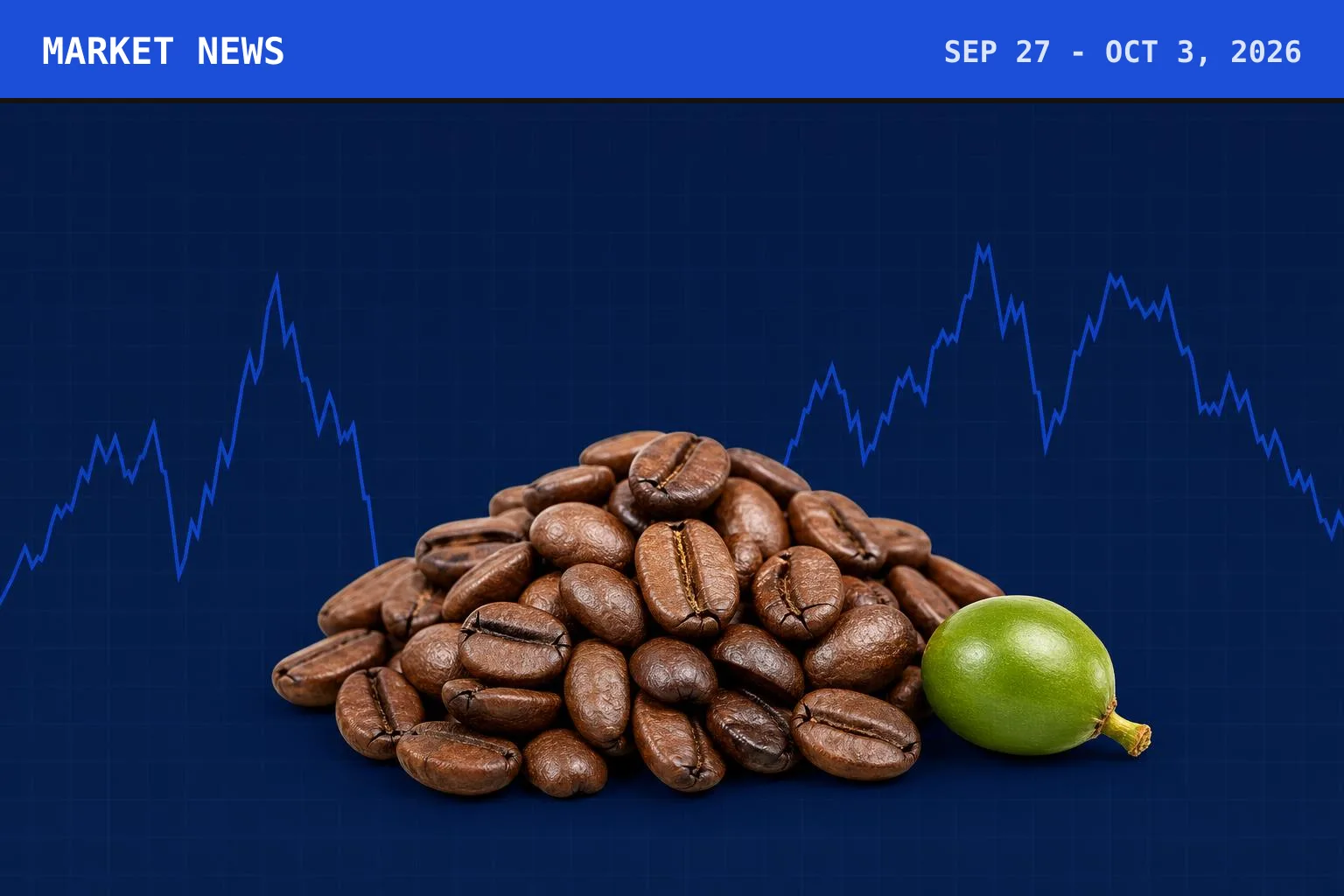
The week that ran from September 27 to October 3 was a recovery week for coffee, but a nervous one. After arabica slid to a three-month low on September 23, futures bounced back this week on short-covering and a forecast for dry weather over Brazil's flowering regions.
That is the week in one line: prices rose, but on sentiment rather than scarcity. The heavy-supply story underneath has not changed, which is why the bounce faded into Friday rather than running away.
The market: a technical bounce, not a trend
| Market | Price | This week |
|---|---|---|
| Arabica (ICE Dec) | 290.72 ¢/lb | +1.5% |
| Robusta (ICE Nov) | $3,445/tonne | +2.3% |
December arabica gained about 12 cents from Monday through Wednesday, roughly 4.3%, to reach a three-week high. November robusta added about 78 points, around 2.3%, to a one-month high.
Much of that move was short-covering: traders who had bet on falling prices buying back their positions as a dry Brazil flowering forecast raised a small flag over next year's crop. On Monday arabica closed up 3.6%, then on Tuesday it steadied and edged 0.1% lower to $2.8845 per lb, with robusta slipping 0.5% to $3,370 a tonne.
By Tuesday September 30, Arabica C had closed at $2.95 per pound, up 1.9% on the day, and ICE robusta settled at 3,445. Into Friday the tone softened again: arabica rose 0.86% on October 2 to 290.72 cents, leaving it up roughly 1.5% on the week.
Uganda's agriculture ministry logged Friday's settlements with that same split tone. Robusta gained US$3 per tonne on the November position, while arabica closed 2.45 cents lower on the December contract. The two beans are quietly drifting apart, with robusta firmer and arabica still weighed down by Brazil.
Step back and the picture is still bearish. Arabica is down about 1.57% over the past month and down 25.60% against the same time last year. The reason is simple and sits in the ports.
Brazil's coffee exports are on track to set a record in September, with shipments to date running 34% higher than a year earlier as the country finishes a record 2026 harvest. A dry forecast can spook a market for a few sessions, but a record crop moving out of the warehouses is the heavier weight.
Stocks tell the same two-sided story. ICE-certified arabica stocks stayed close to historic lows, which keeps a floor under prices, while robusta stocks sat near nine-and-a-half-month highs, which caps them.
In Vietnam, the robusta story is quiet for now. Farmers in the Central Highlands sold beans at 94,000 to 94,800 dong per kg, slightly up on the week, and the country officially entered its new crop year on Thursday. Fresh beans are unlikely to arrive in bulk before early November, so the market is simply waiting.
For anyone buying coffee at the shelf, none of this changes much this month. Prices are off last year's highs but still elevated, and a one-week futures bounce does not reach your bag before the pricing works through roasters and retailers.
Starbucks starts closing 250 cafes
The biggest name news landed on the high street. The second wave of closures that Starbucks announced on September 24 began showing up this week, with customers starting to see signs on affected cafes over the weekend.
The company is closing roughly 250 North American locations, about 1% of a footprint of some 18,000 stores. It now expects about 440 net new coffeehouses in fiscal 2026, down from a previous forecast of 600 to 650.
That is a meaningful slowdown for a chain that built its brand on being everywhere. For most drinkers it means a nearby store may vanish; for the specialty world it is a reminder that even the giant is trimming rather than expanding.
Starbucks also made quieter news on sustainability. The Financial Times reported midweek that the company has revised or abandoned pledges to halve waste and water use, and is reconsidering a goal to cut carbon emissions by a similar amount.
Keurig Dr Pepper names a spinoff CEO
On October 1, Keurig Dr Pepper named new leadership for its Global Coffee Co spinoff. The appointment follows an awkward gap: former JDE Peet's chief Rafael Oliveira had agreed to take the role, then joined Heineken in July.
The plan is to split the business into Global Coffee Co and a separate Beverage Co, with the separation expected in the first quarter of 2027. It is a structural move aimed at traders and investors, but it matters for drinkers too, because Global Coffee Co will sit behind a large slice of the pods and grocery coffee sold in North America.
Nespresso rethinks its paper capsules
On October 2, trade press reported that Nespresso plans to phase out its home-compostable paper coffee capsules. The detail is small, but it rhymes with the Starbucks sustainability news: another major player stepping back from a green promise that proved harder or costlier than hoped.
For anyone who bought into compostable pods as the guilt-free option, it is worth watching what replaces them. The direction of travel across the big names this week was retreat from the headline pledges, not progress toward them.
Elsewhere in coffee
The week's most eye-watering number came from Panama. Best of Panama results were announced, with the 2026 auction drawing nearly 25,000 bids and generating sales of more than US$3m.
The top lot was an Elida Geisha Torre from Lamastus Family Estates. The 15kg lot sold for US$270,060, which works out at US$18,004 per kilo.
That is trophy territory, not daily drinking, but the same estates sell washed geisha lots you can actually brew. If you want to taste what Panama's geisha fuss is about without the auction price, a Lamastus washed geisha is a fine place to start.

In Geneva, the International Coffee Organization made a more useful contribution to everyone's homework. On September 30, during the 142nd International Coffee Council, it launched a free interactive data platform covering global prices, trade, production, consumption and certified stocks.
For readers who like to check the numbers themselves, a single free source for all of them is genuinely handy. It also makes recaps like this easier to fact-check, which we welcome.
In US retail, Map It Forward launched CoffeeListings.com, an online marketplace for green coffee, equipment, services, jobs and businesses, reporting more than 40 listings after its September 17 public launch. And on the mainstream shelf, Dolly Parton's Cup of Ambition coffee line launched, a reminder that celebrity coffee shows no sign of slowing.
What this means at the cafe and the shelf
The through-line this week is caution. Futures rose on a weather forecast and a wave of position-covering, not on any new shortage, so the move says more about trader nerves than about what is in the ground.
The real supply signal still points down. A record Brazilian harvest and record September exports are the gravity the market keeps fighting, which is why the bounce lost steam by Friday.
For your own buying, the advice does not change. Elevated but easing prices make this a reasonable moment to stock up on a washed Brazil or Colombia you drink daily, while the showpiece naturals and geshas stay priced on scarcity and hype rather than the futures board.
Worth watching next week
Two things. First, Brazil's weather: if the dry flowering forecast holds or worsens, expect more short-covering spikes, but treat them as noise against the record-crop backdrop until the rain picture is clearer.
Second, Vietnam's new crop: the harvest year opened Thursday, and the first real flow of fresh robusta in early November will test whether those near nine-and-a-half-month-high stocks keep a lid on prices. For now, brew what you have and enjoy the calm.