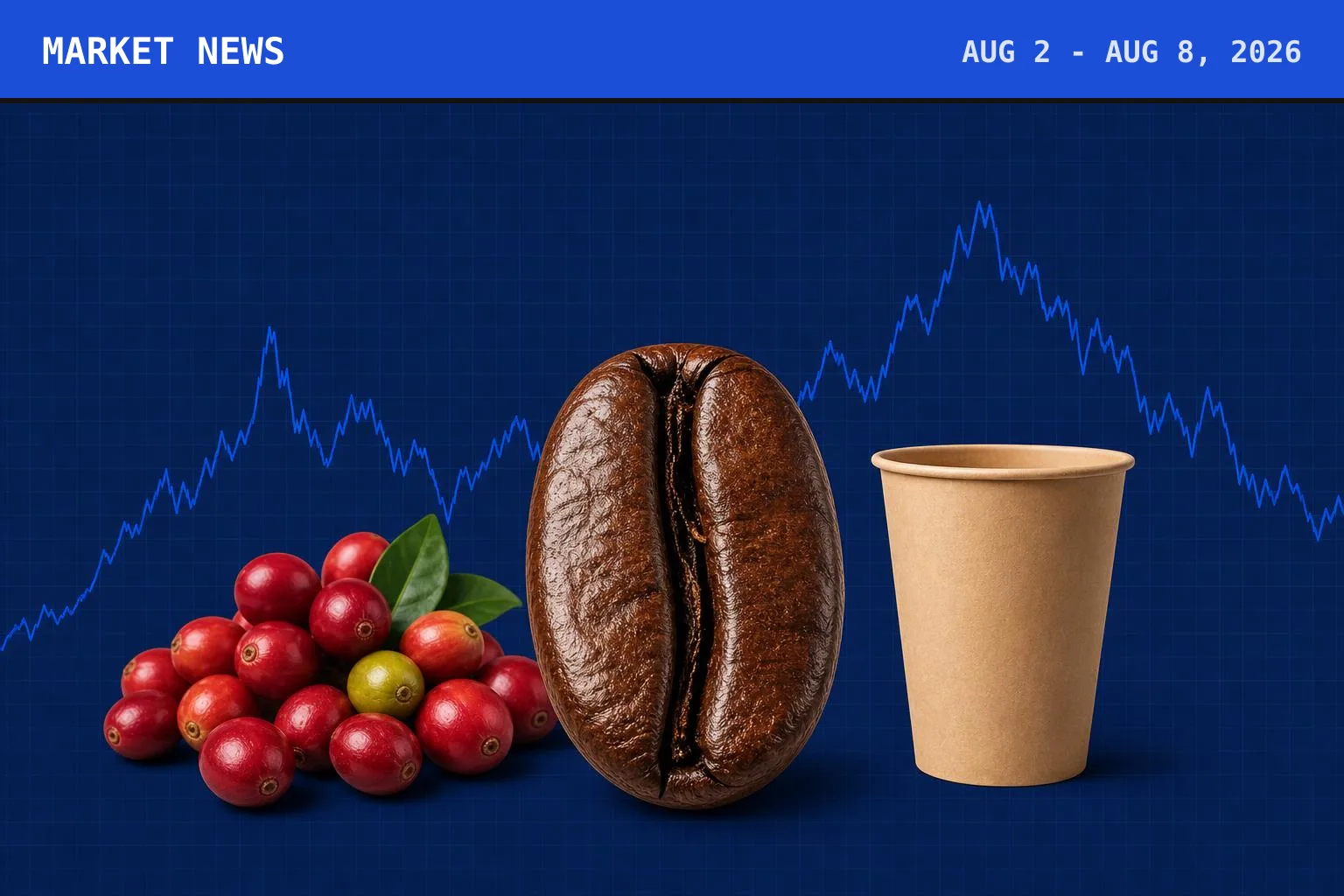
Coffee spent this week caught between two forces, and the weather won. Dry, harvest-friendly weather across Brazil promised a faster pick, and that outlook dragged arabica lower even as exchange stocks kept draining.
For anyone buying beans, the takeaway is calm: prices are still in the low $3.00s a pound and moving sideways-to-down, not spiking. The drama this week was in the daily swings, not the destination.
The market: harvest weather versus draining stocks
| Market | Price | This week |
|---|---|---|
| Arabica (ICE Sep) | 307.76 ¢/lb | -3.45% |
| Robusta (ICE Sep) | $3,775/tonne | -2.80% |
Arabica opened weak. On Monday the September contract closed down 12.60 cents, a 3.79% drop, as drier Brazil weather pointed to a quicker harvest and easier drying.
Tuesday brought a bounce: prices rose 1.44% as short sellers covered positions after an unexpected chance of rain appeared in the forecast for Minas Gerais, Brazil's key arabica belt. That reversed again midweek, with Thursday's session closing down 1.61%.
By Friday, arabica sat near 307.76 cents a pound, roughly $3.08, ending the week modestly lower after all the back-and-forth. The whole story was weather timing: dry spells that let cherries dry and speed the harvest read as bearish, while any rain threat that might slow drying sparks a quick rally.
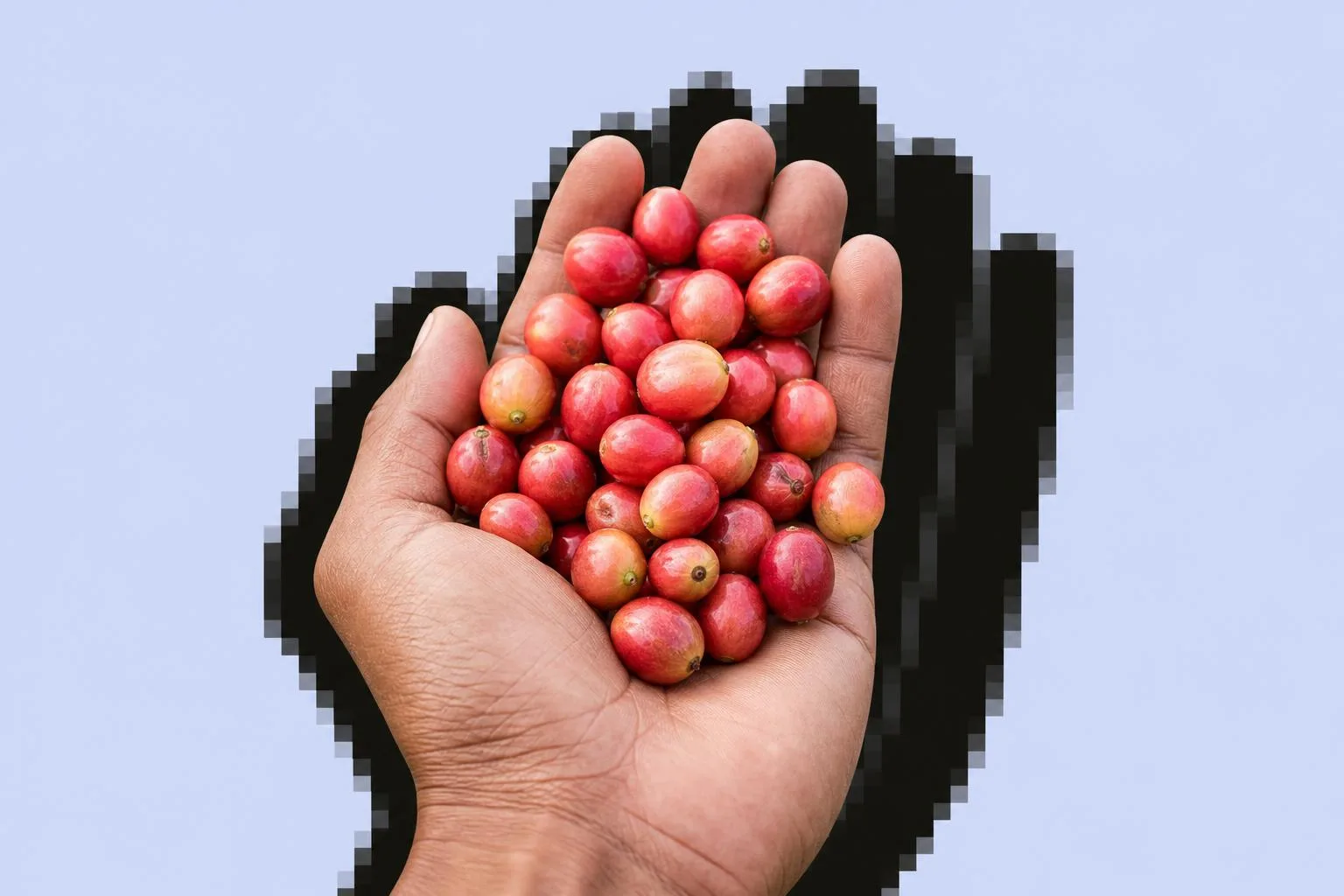
That sensitivity is worth understanding. Once a coffee cherry is picked, it has to dry down to a stable moisture level before it can be milled and shipped, and rain on a drying patio can stall that for days. So traders read a dry forecast as coffee arriving sooner, and price it in fast.
The bullish counterweight is inventory. ICE arabica stocks fell to a 2.5-year low of 260,720 bags on Monday, extending last week's slide below 300,000. Thin exchange stocks usually put a floor under prices, which is part of why the week drifted rather than collapsed.
Those certified stocks are the coffee the exchange itself can deliver against futures contracts. When the pile shrinks, buyers who need beans right now have a thinner cushion, so even a bearish harvest story struggles to send prices into freefall.
Brazil's harvest is still running behind. Among members of Cooxupe, the country's largest cooperative, the pick was 67.3% complete as of 31 July, trailing last year's 74.2% pace. Dry weather should now help it catch up, which is exactly what pressured prices.
Robusta had its own choppy week and ended lower. Values touched a one-week high on Wednesday after rain chances eased for Vietnam's Central Highlands, then London futures gave way, sliding 2.8% to $3,775 a tonne from $3,884 as the physical supply balance shifted toward sellers.
The two markets are pulling apart on stocks, too. While arabica inventories hit a 2.5-year low, ICE robusta stocks climbed to a 4.25-month high of 4,254 lots in late July, a bearish signal that helped cap London's brief rally.
The supply picture behind both markets is heavy. Vietnam's first-half 2026 exports rose 7.3% year on year to 1.05 million tonnes, and the USDA forecasts record global output of 189.7 million bags in 2026-27, up 6.0%. The main wildcard is an El Nino that could delay Brazil's September and October flowering rains, which would threaten next year's crop.
The longer-term picture is still elevated, though. The International Coffee Organization's July indicator prices showed a composite near 291 cents, with Colombian Milds at 390.43, Other Milds at 365.08, Brazilian Naturals at 325.12 and Robustas at 185.98 cents a pound, all up sharply from June's lows. Those are monthly averages, not this week's moves, but they explain why your bag has not got cheaper yet.
The big names
Starbucks kicked off pumpkin season on Monday. The chain unveiled its 2026 fall menu, with the Pumpkin Spice Latte and new drinks including a spiced Chaider arriving on 25 August, and CEO Brian Niccol reiterated there are no plans to sell the PSL year-round.
That scarcity is the point: the seasonal launch is one of the biggest sales events on Starbucks' calendar, and keeping it to autumn protects the ritual. A drink you can only get for a few months pulls people back through the door in a way a permanent menu item never does.
Keurig Dr Pepper reported on Monday, and the headline looks dramatic. Sales rose more than 75% to $7.31 billion, driven by its JDE Peet's acquisition.
The detail matters more than the total. Its US coffee business saw sales fall 3.2% to $918 million as volumes dropped 8.2%, only partly offset by a 5% price rise, and much of that reflects a reporting change that moved Peet's K-Cup pod sales into the JDE Peet's segment.
Strip out the accounting shuffle and the underlying signal is soft at-home coffee demand in the US: people are buying fewer pods and paying more for each one. That is the same higher-green-price squeeze the futures market has been flagging for over a year, now showing up on the shelf.
Luckin, meanwhile, kept sprinting. On Tuesday the Chinese chain reported opening more than 5,000 new stores in the first half of 2026, with second-quarter revenue up 28.5% to $2.34 billion.
It ended June with 36,310 locations, added 2,714 net new stores in the quarter, and hit a record 112.7 million monthly transacting customers. That pace of opening is unlike anything in Western coffee retail, and it makes China's demand a growing swing factor for global bean prices.
Lavazza rounded out the week's launches. On Tuesday it brought its Tabli 100% coffee-tab system to the US, a plastic-free single-serve format aimed at capsule drinkers who want less packaging waste. It is a bet that the convenience crowd will trade one habit for a tidier one.
Elsewhere in coffee
The week's showcase for top-end coffee was Best of Panama 2026, which marked its 30th edition. Finca Lerida took first in Geisha Natural at 95.63 points, and Altieri Specialty Coffee won the Varietals category at 93.63 points.
Both estates are names specialty drinkers can actually buy from. The catalogue carries Panama lots from each, including washed and honey Geisha from Finca Lerida and a washed Geisha from Altieri, so the auction results are a useful map of where to point your money.
A washed Geisha is the classic entry to Panama's signature style: transparent, floral and citrus-driven, the opposite of the wilder natural lots that win the naturals class. If you have never tasted why Geisha commands its prices, a washed lot is the clearest window.

If you want the Varietals winner's estate, the Altieri washed Geisha is the one to try. Both are 100 gram lots, which keeps a competition-grade coffee within reach without committing to a full bag.
On the equipment side, Danish roaster manufacturer Aillio opened a new Latin America headquarters and showroom in San Salvador on Wednesday. The 1,100 square foot space offers live roasting demos and training and opens to the public on 10 August, a small sign of specialty roasting infrastructure spreading closer to origin.
There was fresh health research too. A new study of coffee drinkers in southern Italy, published on 5 August, found that daily espresso or moka-pot drinkers were less likely to develop liver disease. It is one observational study, so treat it as a reason not to worry rather than a reason to drink more.
And on Thursday, Jittery Joe's Coffee was named among Newsweek's Best Premium Coffee Brands of 2026, a nod for the Georgia roaster and a reminder that recognition increasingly reaches beyond the usual specialty circle.
What to watch next week
The single number to watch is Brazil's harvest pace. If dry weather holds and the pick catches up toward last year's rhythm, arabica has room to keep drifting lower.
The counterforce is those ICE stocks. With arabica inventories at a 2.5-year low, any real rain threat to Brazil's drying, or to its spring flowering, could snap prices higher fast.
For drinkers, none of this changes the shelf overnight. Roasters buy months ahead, so this week's dip will not reach your bag soon, and the July indicator prices say the market is still historically dear.
If you would rather not track futures, let the cup decide instead. Browse the full catalogue or use the decision helper to find something you will enjoy whatever Brazil's weather does next. Bright, washed Colombia and floral Ethiopia both stayed well-stocked this week.